Untitled 909 x Refuge Worldwide 001: Ben Sleia & Katiusha


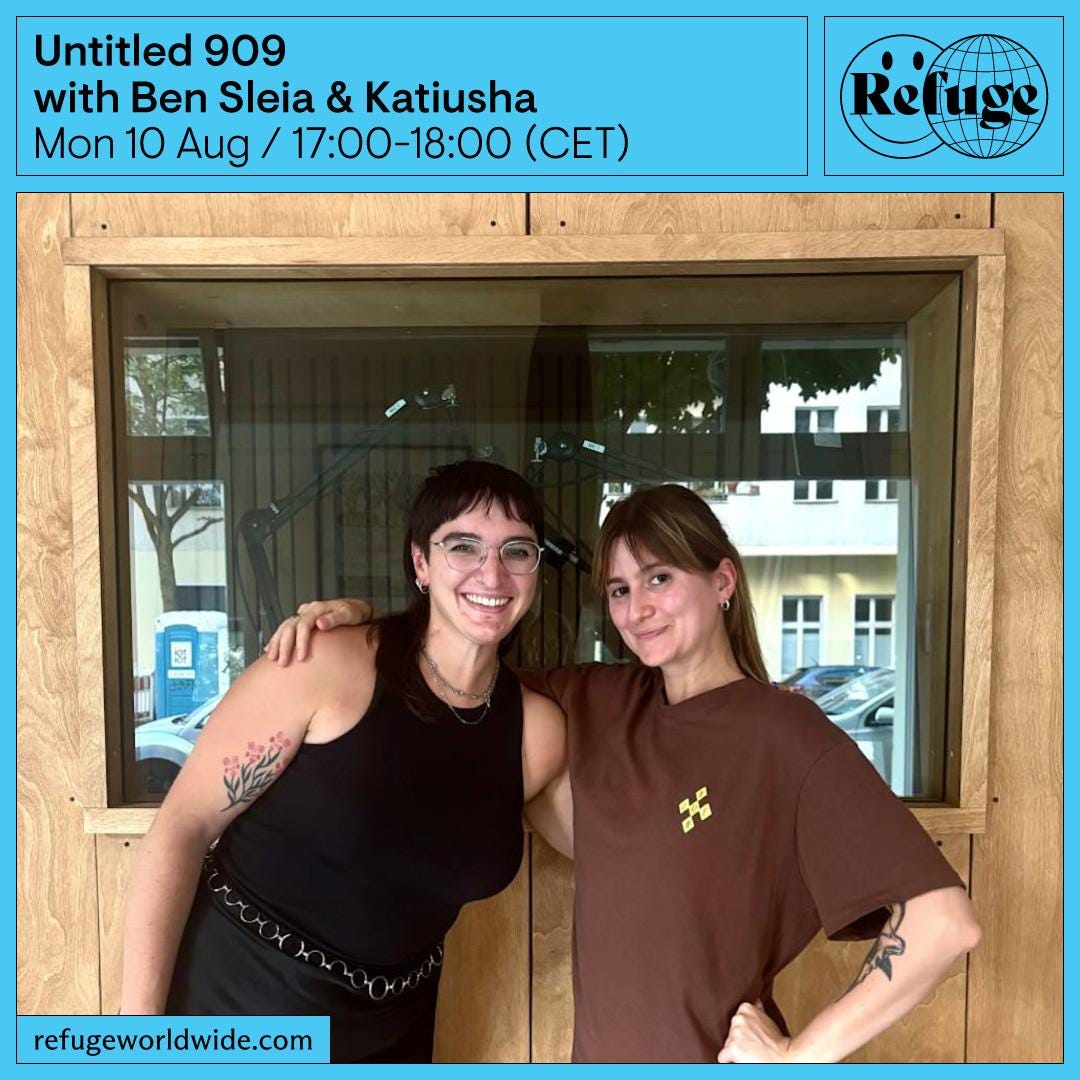
As of August, the Refuge Worldwide residency of Untitled 909 became a podcast series. For the first one, Ben Sleia invited Katiusha, a DJ, producer, and label owner based in Berlin and running the label Grace. After starting the project just over two years ago, and getting more into production during recent years, Katia, aka Katiusha, celebrated the release of her first full length EP on the label last spring. They spoke about what it means for her to be wearing all of these hats simultaneously, how each of them also affect her own artistry, and how ultimately, it all boils down to liking music and wanting to share that.
Listen to the show here:
Katiusha, welcome. Can you introduce yourself for anyone who isn’t familiar with you and your work?
I’m Katiusha. I’m a DJ and producer under the name Katiusha. I’ve also been running a label called Grace for the last two years, since 2024, and I live in Berlin. That’s all you need to know.
I wanted to speak to you because you released your first full-length EP this year on your own imprint, which was a big milestone. It’s also been a couple of years since Grace launched. At the time, you did a lot of press and outreach to get the word out, which was really great, and it feels like you’ve had a lot of positive feedback and engagement around it.
I wanted to know how the curation of Grace has evolved since the beginning. From what I understood, initially you started Grace because friends were sending you tracks that didn’t have a home anywhere, and you thought: “I like these tracks, why don’t I just release them?”
It’s an interesting one, because that did happen at some stage, but it actually wasn’t the first reason why I wanted to start a label. The original motivation was more that after DJing for a while, and then producing for a couple of years, I wanted to start a project that was specifically about working more with other people and platforming other people’s music as I’d really felt the impact of people platforming me. A lot of the friendships I made with people who released on the label actually came about as a result of releasing their music.
There was definitely an element of people sending me stuff. For example, Elliot, aka Harba, sent me a folder of tunes, and that was the first time I thought: “Wait, these tunes are sick. Maybe I should start a label.” He was sending me music that wasn’t released. We didn’t actually end up making an EP together, but it’s funny because I know a lot of people have that experience where their whole friend group is sitting on loads of unreleased music, and that becomes the reason for starting a label.
For me, it felt a little more abstract at first, and then the relationships came afterwards.
That’s really interesting actually. How often do people send you music now as a label owner?
Good question. I probably get demos in my inbox at least once a month. It varies. There are some people I know who will send me things over Instagram. Sometimes it’s a mixture of things that are already released and things that are unreleased. They might not explicitly say “this is a demo”, but they’ll say: “Hey, this is some stuff I’ve been working on.”
Then there are other times, usually from people I don’t know, where they’ll send something to the Grace email inbox and say more explicitly: “This is a folder of tunes that I think could be a good fit for Grace.” That would happen at least once a month. Sometimes I’ll get more in one month, sometimes less.
Looking at the artists you’ve released so far, georg-i & Older Brother, Lurka, the remixes by Jan Loup, Minor Science, and so on, do you think most of these relationships grew out of working together?
It’s a combination. Like I said, I feel like the close friendships came afterwards. To give two examples: I didn’t know Jan Loup before she did the remix of georg-i & Older Brother’s track “Foundations”. She happened to be moving to Berlin around the same time, and since then, which has only been in the last six months, we’ve become really close friends. We’ve done a back-to-back and we’re doing another one later this year. It feels funny that I was asking her to do a remix before I knew her, because now we’re close.
Then there’s the opposite example with Ben, aka Lurka. We’d been friends for a few years, mostly exchanging book recommendations. We weren’t even really talking about music. I told him I wanted to start a label, but it was never like: “I’m telling you this because I want you to release something.” We were just friends talking about music and he was encouraging me. Then at some point he sent me a remix he’d done for Ossia. It sounded quite different from his usual tough, intense productions. There was a new aspect of his sound that really intrigued me, and I thought: “Maybe Lurka could release something. Maybe he could send me some more stuff.” But obviously Lurka didn’t need a home for his music. I wasn’t uniquely giving him a platform because he had already released a lot. It was kind of accidental. I never intended to talk to him about the label because I wanted him to release something. It happened naturally.
I think that’s actually a really interesting point. You said: “Lurka doesn’t need me to release his music.” But maybe you gave him a platform to showcase another side of his sound.
Yeah, for sure. That’s a really good point. I was really honoured to discover that he hadn’t actually released a full-length EP in a while. He’d done lots of remixes and compilation tracks since before the pandemic, but the one that came out on Grace in 2025 was his first proper EP since 2019. He’d been on other labels before like Wisdom Teeth, Timedance, and other established labels, but this was the first time he’d done something like this. There was one track on the EP that used a sample of a woman on YouTube who’s kind of a crystal-healing type person. I don’t really understand what led Lurka to watch that video, but he was intrigued by her voice and what she was saying. He sampled it and turned it into this really skippy, trippy, but also delicate track, especially compared to his usual style. I think for a lot of people, that ended up being their favourite track on the EP. He almost didn’t release it because he was worried she was going to come for him, or put a hex on him, or something, but I persuaded him. I was like: “I think the world needs spells.”
One thing you spoke about a lot when you launched Grace was building a label that was financially sustainable for artists. Now that you’ve had a few releases and a bigger roster, how do you feel that vision has held up in practice?
I’m really glad that I went for the upfront producer fee option. I know that bigger labels with more money behind them often pay artists advances, but for smaller DIY independent labels like Grace, it’s less common because you have to watch every penny, especially when you’re building from the ground up. I understand why the model exists where producers are paid on commission after costs are covered, but I was really uncomfortable with that idea. I also had the privilege of having savings from DJ bookings as well as a regular day job, so I was able to say: “Okay, I’m going to pay you at least an amount that I would get paid for a DJ set.” If I played a two-hour set, I might get paid €400. And I wanted a producer who had spent a year or more working on music, not just two hours preparing for a DJ set, to receive at least that.
Now things have started flowing more. I’m really happy with the number of people buying the releases, and I’m proud that each release has reached enough people. When I think about how little I would be paying artists on a rolling basis if I hadn’t paid upfront, I really stand by that decision.
Has it felt sustainable for the label itself to adopt this structure?
Yeah, it has. It’s interesting because next year I might not do a release in the first half of the year. Partly because I need time to properly curate the release after the one coming later this year, but also because each release is a financial investment. Even though I save money on things like artwork, it still takes time and money. At the rate I’m releasing now, around two or three releases a year, it feels sustainable.
I guess that’s the golden ratio.
Yeah, hopefully. A lot of labels are increasing their release rate because of the Spotify model; putting out more singles, keeping the Bandcamp release emails coming, constantly posting, but I’m really not interested in doing that. I love when a label releases something infrequently and then it appears in your inbox and you think: “Oh, sick. A new one.” It makes it feel special.
I guess that’s also due to algorithmic needs, right? The more you post on Instagram, the more your posts will be seen, and if you have more and more releases to promote, you will get seen more.
Yeah, but I also wonder how it feels for artists when labels release something every month. Do they feel like their releases are special if they only have a few weeks before the next artist comes along? I don’t know how I would feel if my music went through a promo cycle of less than a month before the next artist’s music is due to come out. I’m sure those labels have their reasons and there are benefits, but personally I wouldn’t want that.
I’m also interested because you come from a DJing background, this is what you were known for in Berlin and further afield; do you think that digging has inspired you to run a label, and do you often feel like the music you’ve digged for could have belonged on Grace?
Absolutely, for sure. I think that, for any creative practice, you’re always interested in what people are up to and what’s possible. I think that once you also get into the flow of curating from a label perspective, it’s like a muscle that gets trained to be curious and alert to specific sounds or moods. So yeah, that definitely happens.
Can you think of any artists that make you feel like this?
For sure, I will shoutout Softi, who I think is really cool. I’m intrigued by the way her tracks work in the mix because they are very soft but in the right context they have this kind of force of mystery which works so well as a layer in tandem with another track. I’ve had this kind of feeling of slow burn respect for her output, also because I think she has quite a DIY approach to it. She’s self-releasing on Bandcamp and I think she’d be really cool for the label. I think people also like NVST spring to mind, as kind of a Lurka-adjacent bass musician who’s also working very interestingly with her voice. I love a vocal, especially mangled vocals, but she’s also working with negative space in a way that lends an elegance to the bass music. So yeah, just two examples of many people I would like to see on Grace!
You had your first release on Peach Discs, Shanti Celeste’s label — well, Shanti’s label first, and then Gramrcy joined. I’m curious: what do you think has remained constant beneath all those different sonic identities you’ve explored through your different releases?
I think this is actually quite an easy one: it’s the level of detail that I put into my tracks. The one you just played was actually one of the more simple, quote-unquote, tracks I’ve made, in terms of how long it took me to make and the amount of stuff happening inside; the number of elements coming in phrase by phrase. I remember playing it to someone and they were like: “Oh my God, there’s so much stuff going on inside.” And I was like: “Really? Still?”. I think it can actually be a weakness sometimes, because especially when tracks are being played really loud and mixed with other tracks, simplicity goes a long way. Having a very clear intention in a track is really useful. So I’m actually trying to reduce the amount of detail I put into each track. But that’s something that has always been present in most of the tracks I’ve released. There are usually quite a few layers and lots of intricate little elements alongside the main ideas.
That’s interesting, because making tracks that are functional is what comes to my mind when you say that. It feels like it comes from a DJing perspective; making a track that can do something in a set, at whatever moment you might play it.
Wait, are you saying that’s what I find hard?
No, I mean that’s what I think of when you say you’re trying to reduce the details and make something with a specific function.
I’m actually saying it the other way around: I do put a lot of details in, but I’m working towards getting to a place where it can also be described by the function. For me, that’s actually one of the strangest parts about producing after DJing for such a long time. There are some things that are easier to understand, like the 16-bar or 32-bar loop structures of most electronic music. If you completely break away from those formats, you’re making things much harder for DJs. Same if you put your grid at something like 36.92 BPM and people are like: “Why?” But with the amount of sound information inside a track, that’s something I’ve had to learn. I’ve found it really useful to play my own tracks in mixes while I’m producing them. I’m doing that more and more now, because when you’re working on something alone, you become so used to hearing it as this standalone piece of work. You think: “This needs to be doing everything.”, and actually, no. It only needs to be doing maybe 50–75% of something, so another track can come in and shake hands with it.
How do you approach releasing music on your own label compared to releasing on someone else’s?
I’ve only released two releases on my own label and one two-track release on another label. Interestingly, the Control Fever EP that I just released was originally meant to be for another label. I first had the idea because another label had expressed interest in two of the four tracks: “Control Fever” and “Trouble in Paradise.” But after those two tracks were accepted, the process of finishing the EP became this huge psychological thriller. I think it came down to not being confident enough in my own vision to enter into the collaborative process with another label. Working with another label requires you to say yes to some things and no to others. You have to be able to say: “This works, this doesn’t work, I insist that this stays, but I’m open to feedback on these other things.” Now I feel much more confident doing that, and I think one of the most freeing things about releasing on your own label is that you can completely remove that feeling of making music for someone else. That doesn’t mean external feedback isn’t useful. I think it’s actually essential. But you need opportunities to make music just for yourself and figure out: “What do I actually want to make?”. That’s the main difference.
I guess offering your music to labels puts you in a vulnerable position. You might have put everything you have into a track and understand exactly why it exists, but it might not resonate with them in the same way.
Totally. You’re trying to find chemistry, it’s a bit like going on a date. You’re both offering a vibe, both sides have expectations, and there needs to be some compatibility for it to work. If one side rejects the other, it’s hard not to take it personally. But eventually you realise it’s just how it works. It doesn’t mean you’re inherently flawed or that you won’t have success elsewhere. It’s just a very difficult, almost impossible-to-describe thing. You don’t know if it’s going to work until it happens. Even with some of the releases that happened on Grace, there were tracks I didn’t accept because I thought: “This is literally just something that doesn’t resonate with me.” I try not to do that where possible, especially with producers whose music I love, but ultimately that’s part of the role.
Do you think having no limitations when releasing on your own label can also be difficult? Is there such a thing as too much freedom?
I think so. With this EP, I managed to avoid that because I’d been working on it for so long that I felt like I really needed to get it out into the world. The music was ready. Also, because I had another EP on the horizon that I needed to finish for someone else, there was a practical deadline, but I think there can be a kind of agoraphobia that comes from having no limitations or boundaries. When you work on your own label, it’s really important to continue having conversations with friends and artists whose opinions you trust. You need some external input so you’re not completely alone in it.
That’s an interesting point because when you announced the EP in March, you spoke beautifully about the importance of the people who encouraged you to finally release it. You also described the EP as sitting somewhere between minimal, prog, bass, and trip hop. Do those genres feel like destinations to you, or are they just different tools you draw from?
I think the genre debate is interesting because it raises the question of why we use those terms in the first place. A lot of genres are geographically contextualised. They come from specific communities and moments in time. Dubstep is a good example. Now, with globalised internet culture, maybe we have less use for these categories, so asking why we use them is almost a philosophical question. I definitely didn’t sit down at the beginning of this EP thinking: “I’m going to make a minimal trip-hop prog and bass EP.”, that would never occur to me. With some of the tracks, like “Control Fever”, I was working with Bruce on the mixdown, and he said: “Your style is so minimal.” and I was really surprised because I didn’t associate it with that at all. So I think genres are very subjective now. They’re almost like a book cover. They give someone an idea, but they don’t necessarily define what’s inside.
I think that’s also interesting because the EP feels like the product of this whole ecosystem of people you trust, whether it’s Bruce helping with the mixdown, or friends giving feedback and helping shape the work.
Yeah, actually when you put it like that, it’s a really interesting counterpoint to how we usually talk about genres. Something that happens near the end of making a track is that you’re almost finished, the track has a sonic identity, and you’re deeply invested because you’ve spent hours on it; that’s the perfect moment for doubts to appear. You start asking: “What is this track actually? Who wants to listen to it? Why does it exist?” At that point, it’s incredibly valuable to run tracks past friends, not necessarily friends who will give hyper-critical feedback, but people who can reflect something back to you. Someone saying: “I really like this vibe. I can imagine being in a club space while listening to this.” That kind of feedback can be much more useful than being isolated with your own ideas about what a genre should be. You start thinking: “Maybe this is too proggy. Maybe that’s bad. Maybe I should throw everything away.”, and actually all you need is someone whose music you love says: “I could imagine this going off at 3AM.” That’s much more useful feedback.
Yeah, I guess that’s dance music.
Exactly. Dance music.
I remember Mad Miran saying somewhere: “Genres scare me.”
Welcome to the post-genre era. At the same time, genres are still useful because for example, on Discogs, I will dig with many different genres and then I realise it’s not so post genre after all.
Yeah exactly, I think they still have a use! They wrangle their way back in somehow.
I think the issue is when they’re used in a tunnel way: if you tag something with several genres, people might discover it who wouldn’t otherwise. But there’s also the opposite side where people add 70 genres of bass music and you’re like: “Wait, what actually is this record?”
Right. And also, something being called a genre depends on context. Bruce calling something minimal makes sense because he comes from a very futuristic, bass-forward perspective. Compared to his music, something with intricate details, a 4/4 beat, and not being a big room banger might feel minimal. But if you put that same track in front of someone deeply rooted in minimal music, they might say: “What? This isn’t minimal. This is techno, or tech house, or whatever.” It’s completely subjective.
Do you think creativity is more of a communal effort rather than a solitary process?
Yes. I actually think that, at the end of the day, it’s only a communal process. I’m really obsessed with this interview, I think it’s Rick Rubin’s Tetragrammaton interview with David Whyte, the poet, where they talk about creativity and the creative process. They describe it almost as this idea that the creative thing is already existing somewhere, just kind of marinating in the cosmos. This is getting a bit woo, but stay with me. They describe it as a kind of cosmic channel of ideas that’s always running, and if you show up to your studio session or your artist practice, you’re almost like going fishing for that idea. The idea doesn’t completely come from you. I love that idea because it’s a little bit egotistical to assume: “I created this thing from start to finish. I’m 100% the artist behind it.” I like the idea that you’re tapping into something that already exists, and that’s before you even get to talking with friends, playing things to other people, or collaborating. Someone might say: “You actually just need this one thing,” and they add something, or give you a sample. Isaac, aka Kepplrr, who also released on my label, and I have exchanged sounds to use in each other’s tracks. I think it’s much more collaborative than people often imagine, even if the production itself is under one person’s name.
I guess we’re all the product of our influences. What we read, what we watch, what we hear, all of that comes out in our artistic practice.
Exactly. I know there are some artists who are much more insular with their process. I remember reading that Blawan doesn’t listen to other people’s music when he’s making a release. And honestly, that kind of tracks with his sound because his productions feel so completely individual and recognisable. So my argument doesn’t necessarily work for everyone, but then even Blawan collaborates with Pariah as Karenn, so there are always references, influences, and things steering you in one direction or another. So yeah, sorry Blawan, but I think generally creativity is more of a community effort.
I’m also interested in how that translates when you make a remix. You remixed one of georg-i & Older Brother’s tracks for the Remixes compilation. How do you approach that compared to writing original music?
It’s a really interesting question. To oversimplify it, I think there are two approaches:
One is where you maintain the recognisable core of the original track and add another layer or reinterpret it while preserving enough of the essence that it still feels like the same song. Minor Science’s remix of “Foundations” is a good example. He kept the lyrics and the arrangement, but added this really cosmic, electronica, IDM, disco, acid-line element that completely transformed the track while keeping it recognisable.
The other approach is where you take one element, like a vocal, which was really central to the original georg-i & Older Brother track, and use that almost like a sample. That’s closer to what me and Jan Loup did. You take a powerful element and then build something completely different around it. You’re almost using the original track as a sampling tool rather than as a framework.
That was my first remix, and I actually made three different versions because I was trying to figure out what was possible. In the end, the stems were so strong that I used some of them, but then I processed them heavily, adding effects, pitching things around, and transforming them. The result is pretty different from the original, but I also really appreciate the other approach. I think both are fascinating when they’re done well.
I have one last question about this before we move on. You touched earlier on confidence in what you’re making, especially when sending music to labels and working with other people. As a DJ, you learn to trust your instincts, your taste, and your ability to curate. As a label owner, you also have to trust artists and recognise when they connect with your vision. Do you think trusting the music you make is different from trusting your own taste as a DJ?
That’s a really big question, I think it is different. I guess it depends what you mean by trust. Do you mean confidence in your own ideas?
Yeah, exactly. Trusting that what you’re doing is what you should be doing.
I think it’s almost not your job to evaluate your own material. Obviously there’s evaluation and criticism involved, but a lot of the time asking yourself: “Is this good enough? Does this add value to electronic music?” can actually be a destructive question as a producer. You’re creating something. You’re expressing something, I think it’s much more useful to look back on something you’ve already made and then switch into a more analytical mode, because that won’t interrupt the creative process. As a DJ, it’s completely different. You’re making judgment calls constantly about other people’s music. You might listen to hundreds of tracks in a day, so you have to become quite ruthless at deciding: “This is good. This isn’t good. This is good but I don’t like it. This is good but I’m not going to play it.” So there are completely different kinds of confidence.
It’s interesting because it all comes down to liking music, knowing what you like, and knowing how to get there. Whether it’s DJing and creating a certain vibe, or working with artists for the label and knowing they’ll deliver something that matches what you’re trying to do.
One thing that comes to mind is when I was finishing the mixdown for the first track I ever released, “When I Do” on Peach Discs’ compilation. It was my first release, so I was obviously really nervous. The vibe was quite whispery, warm, delicate, dub-house, quite sweet and housey. I went to Panorama Bar for a Fever AM night, and Pariah was playing. It was one of my favourite sets from the last few years; really fun and varied, but also with lots of the tougher techno he’s known for. I came out of that set thinking: “Oh my God, I shouldn’t release this track.”, because I was suddenly evaluating it through my DJ brain. I thought: “Pariah would never play this.”, and I was making assumptions about what a good track should be based on the music I had just heard. The irony is that later he played tracks from my most recent EP and invited me to do a guest mix for his Rinse show, and the track he played from Control Fever was actually the warmest, sweetest, most poetic one, the one I never would have imagined he’d choose. So I think that’s why, as a producer, it can be dangerous to get too stuck in that critical place. You start trying to predict what other people will like, but you actually have no idea. Your job is to make the music, other people’s job is to decide whether they like it.
It takes away from the freedom that creativity is supposed to bring.
Yeah, although it’s obviously easier said than done. You still need critical reflection. I just think there’s a balance.
I want to talk about things more generally now. You’re a DJ, producer, and label owner. Do you think these are all different expressions of the same instinct, curation, or do they satisfy different creative needs?
This is the kind of question you could talk about with friends around a table for two hours, but your point about everything being about inviting people to listen to music you like is really true. My sister actually pointed that out to me. She said: “Your entire life is just about showing people music and asking them to like it.” And honestly, it’s true. I do freelance PR work as well, so almost every waking hour is somehow about sharing music and hopefully enjoying it together with other people. The social aspect of electronic dance music is really important, it’s incredibly communal, but the different roles definitely have different aspects. DJing compared to production is very different. Producing has this private element where you’re alone in a studio and can spend hours editing something. DJing is the opposite. You’re improvising in the moment, often in stressful or overwhelming environments. Sometimes you can’t hear properly, sometimes the crowd is unpredictable. Sometimes it’s amazing and sometimes it really sucks. Production is a controlled environment where you can spend an hour tweaking a 16-bar loop. With label work, the collaborative aspect is what feels unique; you’re inviting someone else into your world and respecting their creative output over weeks and months. That’s the special thing about label curation that doesn’t necessarily happen in the same way with DJing or production.
Do you ever feel pressure to present a coherent artistic identity, or do you enjoy letting people discover different sides of your taste through different projects?
Recently, I’ve enjoyed letting things be more open. There was a moment around 2021 or 2022, maybe after I did the Fact Mix, which felt like the first time I’d done a really important podcast that got a lot of engagement. Suddenly people I didn’t know were saying: “Oh, I listened to that mix.”, and I became quite self-conscious. I started thinking: “Wait, what is my sound? I never really thought about this before, but now I have to define it.” It was actually quite a miserable experience because I became overly aware of trying to create a coherent identity; I had to spend time getting away from that. Now I have more fun thinking: “It’s normal to get interested in one thing one year and something else the next. It’s normal to try different modes.” Sometimes the question still comes up when someone books you. You wonder: “Do they expect me to play one specific thing? Did they listen to one mix and want that exact sound?” Other times it’s clearer. If someone books you for a dubstep night, then you know what context you’re playing in, but it’s a funny question.
Looking back at the last few years, what have you learned about yourself through running a label and finally releasing a body of work that you don’t think you could have learned any other way?
I think that running a label especially, but I’ve definitely experienced this with music production too, particularly when it comes to sharing production with other people and other producers, creates a new layer of curiosity. There’s a new layer of ideas and interest in what could happen that wasn’t really there anymore for me when it came to just DJing. I think that’s why I started to feel this craving at that time to embark on a new project: something that brought more people in and created more opportunities for exchanging ideas. I think opening up your curiosity is the kind of thing you don’t just decide one day: “I’m going to be more curious.” It happens slowly through practice, you start thinking: “What if this person released on the label?” Or someone reaches out to you and suddenly your ideas are operating much more actively. I think that’s something that has affected my life positively in every way. I really love how much more interested in other people and new things I feel. That’s probably the main takeaway.
That’s a big one, it is amazing. That’s it for the interview then. Thank you so much for joining me.
Thank you for inviting me. It’s been really, really nice to have some time to talk about all of this.
Discussion about this post