ophélie & sselkie in coversation
Written by sselkie, recorded live at Refuge Worldwide

From free parties in France to building a more equitable and accessible music scene: a conversation with Ophélie
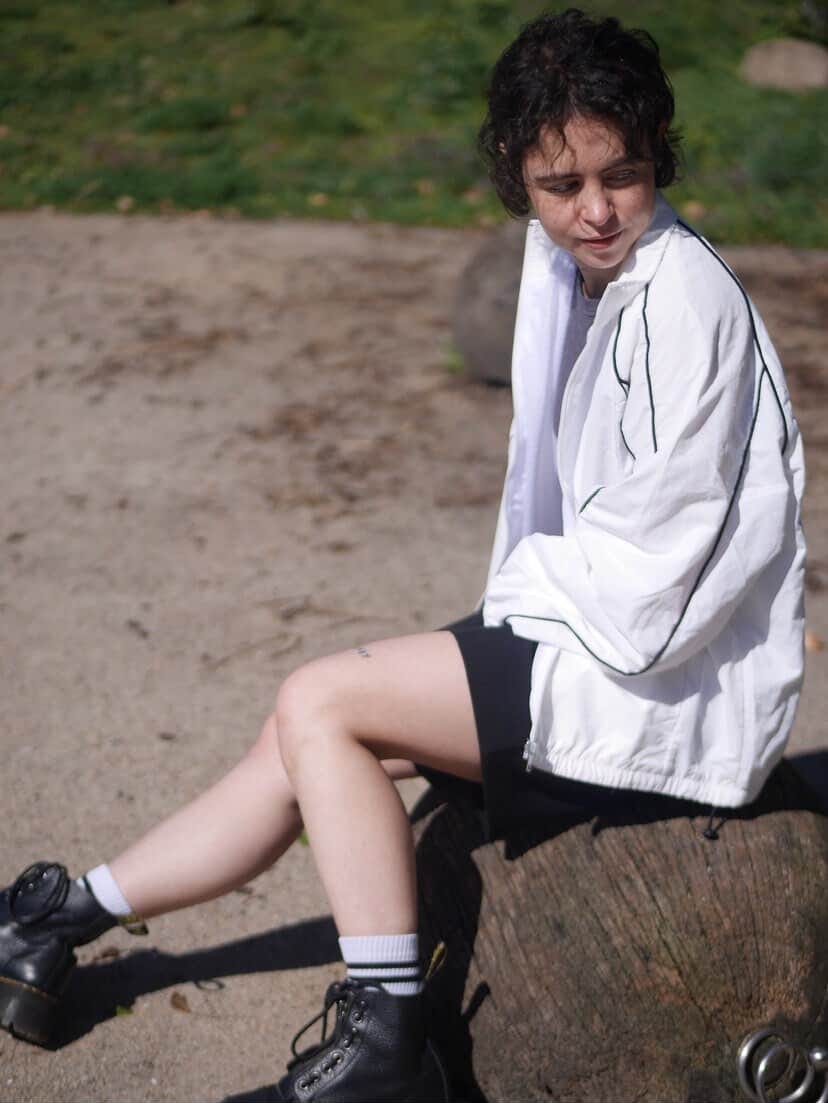
Berlin-based French producer and DJ ophélie has steadily been rising in the Berlin scene with their low end-driven music and carefully crafted sets shaped by UK sound system culture and melancholic sound worlds. For the 9 year celebration of Untitled 909, Berlin-based radio host sselkie speaks to Ophélie about their journey into music, early musical influences, their work with Open Music Lab and on what it means to build a more equitable and accessible music scene.
Audio version:
Let’s start at the very beginning, what was your earliest musical memory (not necessarily electronic)?
I didn’t grow up in a very musical or artistic family, so I didn’t have access to a lot of cool music outside of what was playing on radio or on TV, but I was watching a lot of movies at my grandparents’ where I spent a lot of my childhood and my grandmother would record a lot of movies that I would record over and over again, so my earliest musical memories are more from soundtracks, and I still really love soundtracks. I can remember a lot of Animé soundtracks, one of my favourite soundtracks from my childhood was from ‘My neighbour Totoro’ which is one I really remember. Later on I watched ‘Requiem for a Dream’ a bit too early which traumatised me but I remember the soundtrack very well. I really developed a taste for orchestra and dramatic / emotional music, I simply love soundtrack.
That’s a beautiful early musical memory. Starting with your journey into music and DJing, how did it all begin? What’s your earliest memory of falling in love with electronic music?
There were always elements of electronic music in the soundtracks I loved. Often the soundtracks I loved were a mix of classical and electronic music, for instance I loved the ‘Neverending story’ soundtrack by Girogio Moroder and Klaus Doldinger.
I always really liked electronic music and loved Raï music as a child - Algerian music that was very popular in France in the 90s. Through Raï, I learnt to love percussion and rhythm. Later on I moved onto trip hop and hiphop and stuff like Thievery Corporation, Massive Attack, Morcheeba, and then that led me onto Warp and Aphex Twin, Boards of Canada and all this. But let’s say that as for club music it can be traced back to my teenage years. I was having a really hard time at school as a teenager, I was bullied and also not enjoying school so much as a teenager so it was a bit of a difficult time for me at school and at home. I never really had the ideas of clubs because I knew I was too young - the ideas I’d have of clubs at the time were places to get drunk and hook up with girls, so I wasn’t interested. But one day a friend of a friend that was a bit older brought me to a free party in the countryside close to where I was living, and that’s how I got more into electronic and club music. I really loved it and felt it was the first time that I could disappear and feel like people wouldn’t pay attention to me, I felt like I could do whatever I wanted and it was a really nice feeling so I kept going over and over in my teenage years.
I can definitely relate. Growing up in Scotland my first impressions of clubs were also related to drinking and it wasn’t until some friends took me under their wing that I saw another side of club culture and electronic music parties. But starting with the free party scene in France is a solid entry. On that note, you grew up in the South of France, but have also lived in London and Berlin. Your music has influences of UK bass music. How has living in different places influenced your sound and approach towards music? Has this changed over the years?
Yes so I think for me, France as a teenager life wasn’t about clubs but free parties and the music that was played there - so dub music influences, hardtekk and some trip hop and drum & bass influences. Because I still had the taste for emotional and dramatic music, when I moved to London I gravitated early on towards deep dubstep because it had elements of cinematic and drama. That was the music I gravitated towards in the UK. When I moved to Berlin later on that’s when I discovered more experimental music through Atonal and CTM, or artists like Objekt. I also discovered a different side to techno - I knew it from early on in the form of Hardtekk, but I discovered more cinematic techno and many other genres. Parties like wax treatment were very influential for me because they mixed techno, bass and dubstep.
How long ago did you move to Berlin?
O: 13 years.
Did you observe a shift between pre- and post-pandemic?
Yes but it’s also me. After the pandemic I grew a bit more introverted again and it was a bit more difficult for me to go out again. But the bass community has gained a lot more popularity and more people, more female and FLINTA artists have become more actively popular in the scene which has been a really nice shift. I’ve also seen the presence of more workshops and community initiatives outside the club appearing - like Refuge Worldwide. These were not so present before.
What gave you the confidence to pursue production and when did you start?
Actually it was quite a difficult and painful process with production for me. I started a really long time ago, I started a lot of times but always gave up because I found it very difficult. I started early on when I went to free parties but just to try out simple things. I gave up and at the time I never had a laptop that was good enough to handle production software, I was very limited in what I could do. Usually my laptops weren’t good and I was too shy to ask for advice, I didn’t know people and there weren’t workshops. I was watching youtube tutorials and was too shy to ask friends, especially as they were mostly men. I started more seriously around 2018, when I did a one day workshop and then I started having more time and doing it more seriously at the beginning of covid in 2020. I then managed finally to be more confident, but it was a long process. It definitely did not come easy to me and I still think that I have a lot to learn even after all this time.
What were your early musical influences when you started producing?
I guess there were tracks that influenced me when I started getting more into music. One really free party track was Bad Weather by High Tone. This group was really in the free party scene and influenced by electronic music journey.
You’ve spoken about the free party scene in France, and about how living in London and Berlin has influenced you musically. Where do you look for sources of inspiration outside of music?
I read a lot and books are a big source of inspiration. I really love fctinio and fantasy and sci-fi, that influenced me a lot. Worldbuilding and different worlds and these kind of things have been very influential for me. As well as daydreaming and being in my head a lot, I think I am quite a solitary person. I sent a lot of time thinking and dreaming. As I said before, movies are also an inspiration. I spent a lot of time in front of a TV as a child, I watched a lot of anime and fantasy movies and they are still inspiring to me. Soundtracks of movies are inspiring, as well as nature - especially forests and the ocean because it reminds me of where I grew up. As a teenager, I was really in the triphop and dub scene and really loved Amon Tobin - a lot of his tracks have influenced me but one of the tracks that influenced me most was Foley Room because there’s a lot of sound design and use of different sounds. I found it cool as it opened the way for me to discover new sounds and see that you can do things in music that aren’t just super musical but also sound design-based.
In June last year you released a track as part of the compilation ‘Water Bodies’ on the label Gravity Pleasure. This compilation is one of my favourite releases from 2025 and also always stood out to me because it’s a compilation made entirely of FLINTA* artists and collaborators. When thinking about visibility for FLINTA* artists, this approach is powerful. What else do you think can be done to improve access and representation for FLINTA* artists in the scene?
I think there is still so much to do and to be done, especially when it comes to music production and monroe technical roles and managerial roles in the music industry. I think this has to start early on and before adulthood. One of the advantages of having electronic music a little more in the mainstream is that it can also open ideas and imagination for younger people - male, female or non-binary - to see this as an opportunity and see it as something that is possible to do. I think in the UK it’s maybe a little different and more integrated into the mainstream, and the day to day life already from early on. I also read ‘Dance your Way Home’ by Emma Warren where she also talks about school discos as important spaces for kids and young people to discover dance music and DJs in safer and fun, kid-friendly environments. But I guess in France and many other countries, safe spaces for young people to enjoy dance music is not really in the mainstream or in pop culture and it was even less before. So I think there is no real way that you can get into this as a teenager before adulthood unless you do this differently like me, but I think by then it’s probably already too late because you already learned from childhood that you are not good at technical things and not interested. Having girls and non-binary kids already interested and feeling more able to go into technical things from childhood would really help.
Yeah I think you bring up a very valid point there, also by referring to Emma Warren’s book ‘Dance your Way Home’. She wrote another book called ‘Up the Youth Club’ that was published last year which speaks about youth club spaces in the UK as sites of connection and creation for young people, and how important these are for kids and teenagers. I think increasing access to dance music for children and teenagers is a really important point. On that note, you also work for Open Music Lab in Berlin. Could you tell us a little bit more about your work there and what Open Music Lab does to build a more equitable music scene in the city?
Open Music Lab is a project that is part of an NGO called ‘HejMo’, it used to be called ‘Give Something Back to Berlin’ until the end of last year. We have several projects in the organisation, such as social cooking, language cafés, art and more traditional music classes.the project that I take care ofo inside the NGO is called ‘Open Music Lab’ which is more about electronic music and sound-related things. We do DJ workshops, music production workshops, radio workshops and everything that is around either electronic music or sound studies. All the activities are always free - that’s the concept of the organisation. They are open to everyone but of course we have limited spaces so we prioritise those that wouldn’t have access to these activities in a more traditional or paying context, such as people with refugee background and people from working class backgrounds, people with disabilities, FLINTAs and queers, those with access difficulties. The organisation was created to connect refugees and migrants with people from Berlin.
This is very important work. What aspects of our scene would you like to see evolve or change? How can emerging or underrepresented artists be better supported, within the electronic music ecosystem in Berlin specifically but also speaking from your experience in France and abroad.
The question of access is what we just talked about - for me it needs to be spoken about a lot more, considering who gets a seat at the table, who makes decisions in the scene and on important topics such as money. When it comes to the bigger picture, we slowly have more diversity now - at least on the DJing side, but we still have a long way to go, especially when we think about who makes the money in the end. Access is still very limited for working class people or people with immigration backgrounds and global majority countries. Here in Berlin the scene is still very Western-centric and it’s still difficult for disabled people and people with mental health challenges. Starting earlier on and giving kids access would really improve things, or like you said - through youth clubs - or kids discos, school discos. With open music lab I now try to create more workshops with teenagers if I can and I think there should be more funding for this. Another thing that is important to mention is the way that the scene here and everywhere is going towards a more capitalist direction and following what is happening in the world and what has been happening in the world for a long time. In the electronic music scene this is replicated through the need to always be present online, always doing as much as you can, and through things like Boiler Room being bought by KKR. I find this really hard.
Yes I completely agree, and it also brings up a lot of difficulties when you try to swim against that capitalistic current. What advice would you give to someone at the beginning of their musical trajectory?
I would say to just try things out, enjoy the process and not wait too long or until you are ‘better’ to collaborate with people. This is something I really struggled with - I didn’t want to make music or try things in front of other people because I was so shy. But I think you can only get better when you do it and learn from other people. You probably won’t get better before you are doing it with and in front of other people. If it’s with DJing, just start even when you’re not completely ready. Same with music production, actually most people won’t care and won’t judge. Most people will be supportive.
Yes, it’s important to be seen trying. What’s coming up for you in the coming months?
Tonight I am playing for a fundraiser for Iran and Lebanon, organised by Sara Persico with some live and DJ performances. Otherwise I have lots of nice and exciting gigs and festivals, and other than that I want to get better at making music, better at music production and I also really want to work on a live set. That’s my goal for the future. I love DJing and want to keep DJing but I am also thinking of the future and would love to do more around production and lives, as well as workshops and teaching.
I look forward to seeing where this journey takes you. Thank you so much for the conversation, Ophélie and thank you to Chanel for inviting us to the booth for this Untitled 909 takeover.
Tracklist:
Sulky Slug - ophélie
Pipa Pipa - ophélie
Bad Weather - High Tone
Foley Room - Amon Tobin
Goat Stare - Loefah
The Path of the Wind (Instrumental) - Joe Hisaishi (from my Neighbour Totoro)
Discussion about this post